The Rhythm of Returning to Myself: A Journey Through Art and Healing
- Nangoma Simatele
- Oct 20, 2025
- 5 min read

Embracing Silence in Recovery
There was a point in my recovery when the drama finally stopped. No loud relapses, no interventions, and no emergency phone calls. Just silence. It was uncomfortable. I didn’t know how to exist without the chaos echoing in my head.
That’s when creativity crept back in, quietly but insistently. It wasn’t a lightning bolt moment; it was more like a hum. You know, the kind you feel in your bones before you hear it.
At first, I didn’t think of it as art. I was simply drawing anything to stop my hands from shaking and my brain from spinning. I’d wake up at 3 a.m., step outside to breathe in the cold air, and then slip into my drawing space. I kept the lights low and played soft music. I always draw in pen, never in pencil. I like the permanence of it—you can’t erase it; you can only work with the mistakes. In some ways, that’s how recovery felt too.
Sound as Survival
I’ve always experienced music in my whole body. I don’t just hear it; I feel it vibrating in my bones. During early recovery, I didn’t have my phone. I only had my mother’s laptop, which held all the music my parents had uploaded years ago. Those songs became my lifeline.
There was the gospel music my mother loved—mostly in my native tongue, rich with call-and-response harmonies that sounded like prayers stitched into melody. Then there was my father’s jazz, featuring old Black jazz artists whose horns and bass lines felt like history remembering itself.
In our house, sound had a schedule. Mornings were filled with jazz drifting from my dad’s room. Saturdays, our Sabbath, were soaked in gospel. My music was everything in between: amapiano, Afrobeats, and a little classical when I wanted calm.
When I draw, I dance. That’s why I rarely record my creative process; it’s a little too chaotic, too embodied. I sway, I move, I laugh. It’s not performative; it’s prayer.
Neuroscience beautifully explains this: rhythm activates both the brain’s motor and emotional circuits simultaneously. Movement and music literally synchronise your neurons. This process is called neural entrainment, and it helps regulate your mood, attention, and sense of safety.
That’s why even swaying to music helps your body say, I’m okay now. The rhythm is a language your nervous system understands better than words.
Rituals of the Senses
Over time, my art practice became more than a habit; it became a ritual. Every day began with scent. I’d burn a little frankincense or dab lavender oil on my wrists. Those were the smells of home.
My tradition used those scents for rest, cleaning, and celebration. They carry memories: my mother’s warmth, my father’s steadiness, and the echo of safety I’d almost forgotten.
Scent is powerful because it travels straight to the limbic system, the part of the brain that handles emotion and memory. No detours, no logic—just direct access. That’s why one whiff of frankincense can calm you faster than a motivational quote ever could.
So, I built rituals around scent, sound, and colour: the three languages my brain spoke fluently when words failed.
When Art Becomes Biology
People often think art therapy is all about expression, but for me, it was about reconstruction. Every line I drew and every colour I mixed was my brain trying to rewire itself.
Here’s what was happening behind the scenes:
Dopamine regulation: Finishing a sketch, even a bad one, gives a dopamine reward. It’s not the chaotic surge of addiction; it’s a slow, sustainable signal that says, This feels good; do it again.
Neurogenesis: Creativity literally grows new neurons in the hippocampus, the part of the brain responsible for memory and emotional resilience.
Flow states: When I draw or dance, time disappears. That’s called a flow state, and neurologically, it’s a balanced activation between focus (prefrontal cortex) and relaxation (default mode network).
Vagus nerve activation: Slow breathing, rhythm, and creative movement all activate the vagus nerve—the body’s calm switch.
So yes, technically, art helped rewire my brain. But emotionally, it rebuilt my trust in myself.
Colour as Language
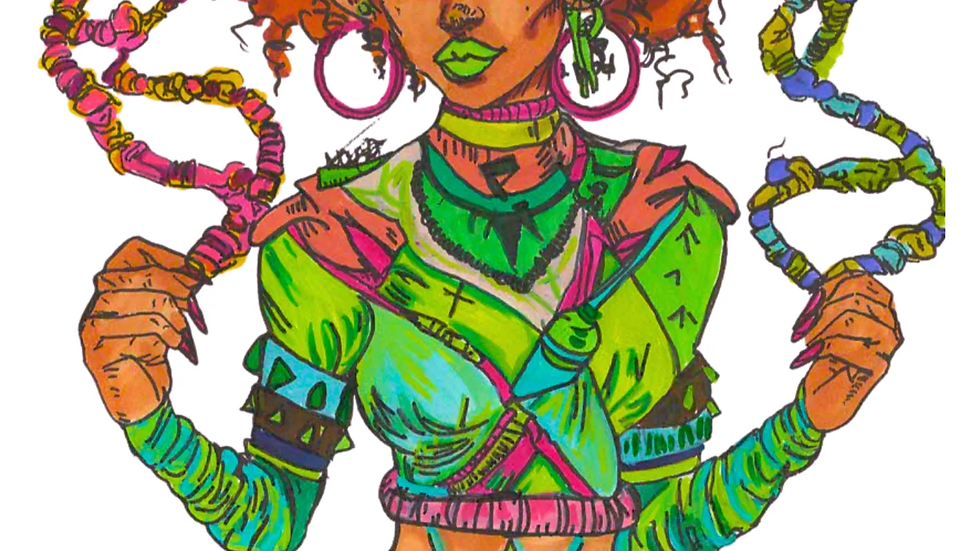
When I started painting again, I thought of it as “painting with reckless joy." My favourite colour is green—emerald, moss, malachite… every shade of growth. To me, green means resilience, grounding, nature, and life.
Then came reds and golds: warmth, vitality, divine energy, and copper, which reminds me of Zambia’s soil and Scotland’s sunsets. I blended earth tones with misty blues and greys, drawing the duality of my life: Zambian roots, South African sounds, and Scottish skies.
I love the spirals and knotwork of both my experiences. Tongan and Lozi patterns alongside Celtic loops and misty Highland shapes. I’m not choosing between cultures; I’m weaving both into my healing. Because both made me.
When I paint, I see ancestral geometry, stories looping through colour. It’s not just aesthetic; it’s neuroscience with soul. My brain associates those colours and shapes with belonging, which rebalances my limbic system and boosts oxytocin, the hormone of connection.
In short: cultural art isn’t just identity; it’s neurochemistry with a memory.
Family, Faith & The Gift of Belief
My family is my anchor. They were the first to notice I was drawing again. My parents would ask me to create things for them—birthday cards, decorations, random projects. They believed I could create anything. I found it funny and endearing because, honestly, I can’t. But their belief was medicine.
That belief rebuilt something in me that therapy couldn’t reach: self-efficacy—the scientific term for “I can do hard things.” Every time I drew for them, my brain logged it as proof of competence, creating new neural links between effort and reward.
Healing through creativity isn’t a straight line; it’s more like jazz. You improvise, you mess up, and somehow it still makes music.
The Brain’s Canvas
If I had to summarise this chapter of healing, I’d say my neurons were learning to dance again. They’d been frozen in fear and repetition for years, running the same loops of addiction and shame. Art gave them choreography: rhythm, flexibility, and purpose.
Recovery isn’t just about abstinence; it’s about reintroducing your brain to joy. And joy, I’ve learned, is a skill. You practise it like scales, brushstrokes, or deep breaths.
That’s the magic of neuroplasticity. It doesn’t demand perfection; it just requires participation.
Journal Prompt
Create a five-minute ritual. Light a candle, play a song that makes your body hum, and draw or write whatever your brain feels. Don’t edit. Don’t erase. That’s your nervous system speaking.
Closing Thought
If my brain were a canvas, recovery would be painted over the chaos—not to hide it, but to turn it into texture.
Next time: Part 4 — “The Science of Relapse, Resilience & Hope." Because healing isn’t linear, and sometimes the brain needs to trip before it can dance.